
The Bushfire Problem: why strategic thinking loses to the inbox
So, you’ve finally set aside an hour to work on your strategy. Nice one! No meetings. Clear calendar. Result.
You settle in and just as you’re about to start, an email from your boss lands. There it is, bold, unread...
Cut to 45 minutes later and you’re deep in a thread about a supplier contract, the strategy document is still blank, and the window has evaporated.
It happens again and again. You might rue your lack of discipline, but your wiring is working against you. Our brains just don’t treat a blank page the way they treat an unread message from the CEO.
We’re wired to deal with what’s right in front of us
Our ancestors didn’t sit around making 5-year plans. Things like a rustle in the grass, a flash of movement or the smell of smoke demanded instant attention because the cost of ignoring them was catastrophic. The ancestor who paused to reflect on the long-term implications of leaving the cooked meal to flee the wild animal did not become an ancestor. The one who ran lived to think another day.
This threat-detection system is remarkably effective for immediate threats like attacking animals, or bushfires. But in modern knowledge work, where the most consequential demands are rarely the most immediate, the most immediate demands are rarely the most consequential.
Yet our mental machinery still operates as if every ping, notification, and request carries the existential weight of a lethal predator. Meanwhile, the strategy document generates no consequence for neglecting it today, so no alarm sounds. You process it more like a suggestion, and the brain files it under "can wait," which is another way of saying "will never happen."
And then, ironically, the strategic gap becomes urgent, and the brain finally pays attention. But by then, you are firefighting rather than thinking.
Why knowing this doesn't help
Here is the really challenging part: you can know intellectually that the strategy session matters more than the email thread, and still find yourself pulled toward the email. The threat-detection system operates below the threshold of your conscious choice. It doesn’t ask permission, but redirects attention before your rational mind has time to notice, let alone intervene.
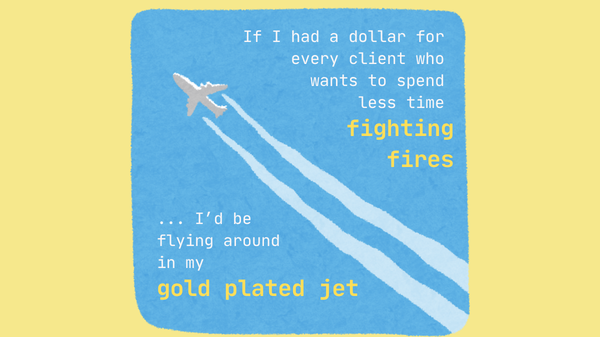
If I had a dollar for every client who wants to spend less time “fighting fires” and more time on high impact work, I’d be flying around in my gold plated jet.
And what they don’t need is advice to "just prioritise strategic work" – that assumes the obstacle is some kind of lack of smarts or tips or willpower. But when you’re asking your brain to treat what it’s categorising as an abandoned apple as more dangerous than a raging fire, of course it resists.
What tends to work better is creating structures that mimic the urgency signals your brain will respond to.
Make the strategic time non-negotiable and socially visible, so that missing it carries a consequence your brain can register. Set a recurring appointment with another person, so there is a social cost to cancelling. Attach a deadline to the thinking, even an artificial one, so your brain files it under "time-sensitive." Remove the competing stimuli entirely. Close the inbox. Leave the phone in another room. Reduce the competition for the brain's threat-detection bandwidth.
These are not elegant solutions. They are workarounds for a system that was never designed for this environment... but over time, you can – at least partially – teach your brain to categorise more accurately even on that subconscious level, so you begin more naturally and easily to deprioritise the junk tasks and push up the important ones.
The question worth sitting with is not how to make yourself think strategically. It’s how to make the strategic work feel as alive and demanding as the thing in your inbox. Get that right, and your attention follows. Until then, expect your inbox to win.
Stop fighting your wiring. If you want support designing systems that protect your strategic time and align with how your brain actually works, drop me a note.
Until next week,
Madeleine
I help accomplished professionals untangle difficult career questions so they can thrive in work and life.
1. Want to find out more? Send me a note and let me know.
2. Feeling unfulfilled, overworked or unclear about what next? Work with me to identify what is holding you back and make a plan for more powerfully and enjoyably pursuing goals that matter to you. Contact me to find out more.
3. Join my list to receive regular articles and insights, early news about programs and offers, and respect for your inbox.
4. Follow me on LinkedIn to stay connected.
5. Prefer to talk? Choose a time and it will drop right into my schedule.
Click below to share this on your socials…